
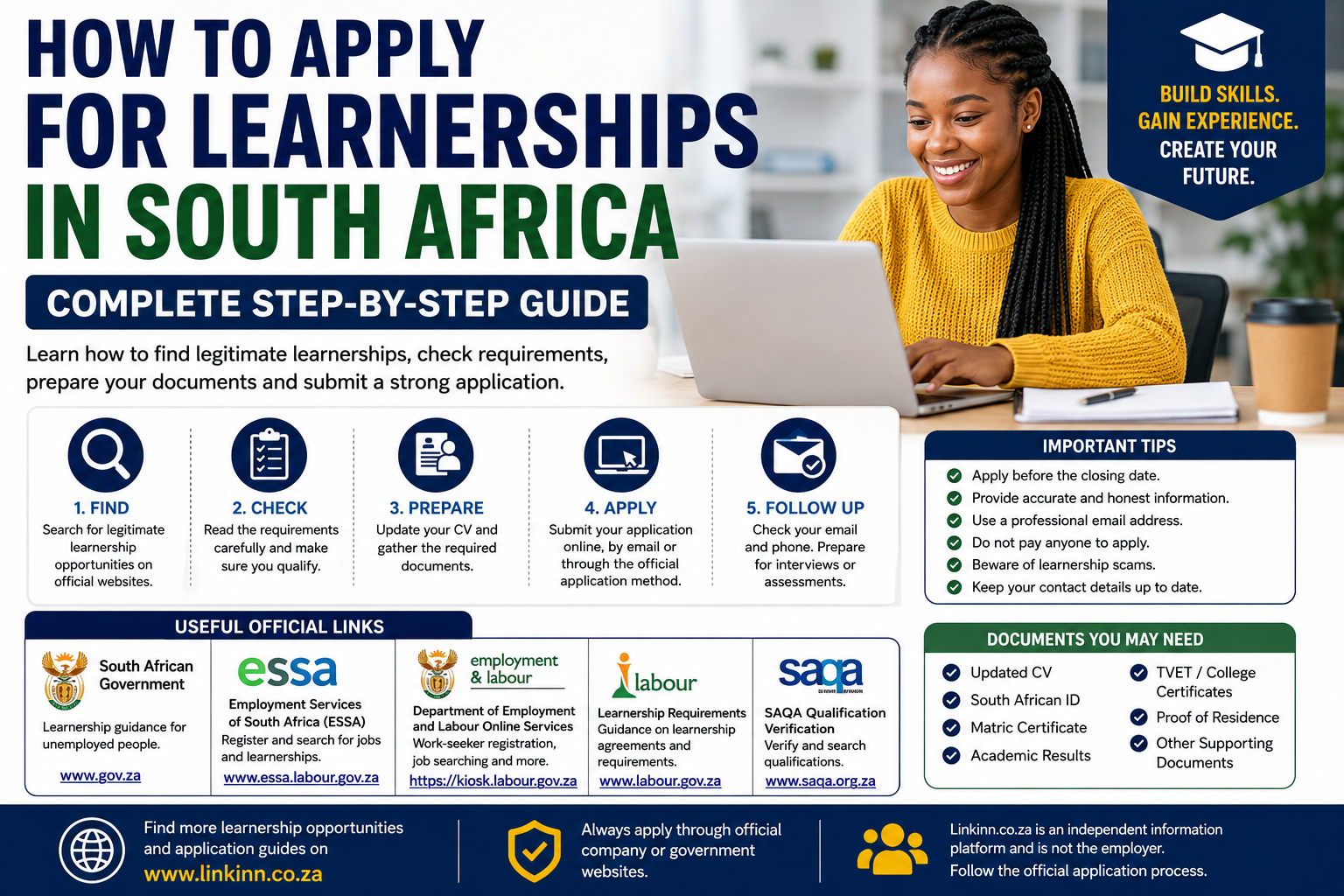
How to Apply for Learnerships in South Africa: Complete Step-by-Step Guide
How to Apply for Learnerships in South Africa
Learning how to apply for learnerships in South Africa can help you avoid common application mistakes and find opportunities that actually match your qualifications.
Learnerships can be particularly useful for people who want to combine structured learning with practical workplace experience.
South African government guidance says unemployed people looking for learnerships can register as work-seekers and can also contact relevant Sector Education and Training Authorities (SETAs) to find out about companies offering learnerships. (Government of South Africa)
However, not every programme has the same requirements.
Some require Grade 12, while technical programmes may require N2, N3, N4 or particular subjects. Other programmes can have different educational requirements.
Applicants should therefore read the complete advertisement before applying.
What Is a Learnership?
A learnership is more than simply attending classes.
Official Department of Employment and Labour guidance explains that a learnership should include properly prepared learning material and practical work experience, and lead to a relevant registered qualification. (Department of Labour)
This combination gives participants an opportunity to develop theoretical knowledge while gaining practical workplace exposure.
Learnerships can exist in fields such as business administration, banking, finance, IT, manufacturing, retail, logistics, engineering, agriculture, insurance and customer service.
The exact programme available will depend on employers, training providers and the relevant skills-development structures.
Who Can Apply for Learnerships?
There is no universal qualification or age requirement for every learnership in South Africa.
Requirements are determined by the particular opportunity.
Depending on the programme, an advertisement may specify requirements concerning:
- Grade 10, Grade 11 or Grade 12
- N2, N3, N4 or another TVET qualification
- Specific school subjects
- Relevant tertiary qualifications
- Employment status
- Citizenship
- Age, where applicable
- Province or location
- Previous participation in learnerships
- Particular skills or experience
Never assume that every learnership is only for applicants aged 18–35 or that every programme requires Matric.
Use the requirements in the specific advertisement.
How to Apply for Learnerships in South Africa
Step 1: Decide Which Career Field Interests You
Start by identifying the type of work you would like to learn.
Someone interested in computers could investigate IT and digital-skills programmes, while candidates with technical qualifications could explore engineering, manufacturing and artisan-related programmes.
Other common areas include administration, retail, finance, banking, logistics and customer service.
Applying for opportunities that match your education and interests can make your search more focused.
Step 2: Register as a Work-Seeker
One particularly useful government resource is the Department of Employment and Labour’s Employment Services of South Africa (ESSA).
The system allows individuals looking for learning or work opportunities to register, capture their CV information and search for available positions. (Employment Services South Africa)
Register and search on Employment Services of South Africa (ESSA)
The Department also recommends that unemployed people register as work-seekers when looking for learnership opportunities. (Government of South Africa)
Step 3: Search for Learnership Opportunities
Don’t depend entirely on Facebook, WhatsApp or other social-media posts.
Use them to discover opportunities if you wish, but verify the information independently.
Useful sources include:
- Employer careers websites
- Relevant SETAs
- Department of Employment and Labour resources
- Legitimate training providers
- Government employment services
- Official company recruitment platforms
Linkinn.co.za can provide summaries and application guidance, but Linkinn is an independent information website and is not the employer or recruiting organisation.
Step 4: Read Every Requirement
Before applying, establish whether you actually qualify.
Check the advertisement for the minimum education, subjects, location, age restrictions if stated, employment status, experience requirements and closing date.
For example, an engineering learnership might require N3 Mathematics and Engineering Science.
Having Grade 12 alone would not necessarily satisfy that requirement.
Step 5: Prepare Your CV
Your CV should make your relevant qualifications and skills easy to identify.
For an entry-level candidate, useful sections can include your contact information, education, qualifications, skills and genuine work or volunteering experience.
If you have never worked before, don’t invent experience.
Instead, highlight genuine skills developed through school, college, volunteering, projects or other appropriate activities.
Step 6: Prepare the Requested Documents
Depending on the programme, you could be asked for documents such as a CV, identification, academic results or certificates.
Only provide documents actually requested by the legitimate organisation.
Don’t automatically send sensitive personal documents to every email address or application form you find online.
Step 7: Complete the Application
Learnership applications can be submitted through several methods.
Many employers use online recruitment platforms. Others may use email applications or legitimate online forms.
Follow the exact method stated in the advertisement.
For an online application, you may need to create an account, enter your personal and educational information, answer screening questions and upload your CV.
Step 8: Check Everything Before Submitting
Before pressing Submit, check your:
- Name
- Telephone number
- Email address
- Education
- Qualifications
- Uploaded CV
- Supporting documents
- Screening answers
Make sure everything is truthful and accurate.
Step 9: Apply Before the Closing Date
Don’t deliberately wait until the final few hours.
Technical problems, internet connectivity or missing documents could prevent you from completing your application.
Apply as soon as you have verified the opportunity and prepared an accurate application.
Useful Official Links for Learnership Applicants
These are good evergreen resources to include in your Linkinn article.
1. South African Government – Learnership Guidance
The South African Government provides specific guidance for unemployed people looking for learnerships, including registering as a work-seeker and contacting SETAs. (Government of South Africa)
Government Guide: How to Register for a Learnership if You Are Unemployed
2. Employment Services of South Africa – ESSA
ESSA allows work-seekers to register and search for learning and employment opportunities. Registered users can capture CV information and search available positions. (Employment Services South Africa)
Employment Services of South Africa (ESSA)
3. Department of Employment and Labour Online Services
The Department’s online services include Public Employment Services for work-seekers, including work-seeker registration, job searching and employment counselling. (Labour Kiosk)
Department of Employment and Labour Online Services
4. Department of Employment and Labour – Learnership Requirements
This resource explains important principles around registered learnerships and their practical-work component. (Department of Labour)
Basic Guide to Learnership Requirements
5. SAQA – Qualification Verification
The South African Qualifications Authority maintains information connected to qualifications on the National Qualifications Framework and provides qualification-verification services. (Saqa)
SAQA Qualification Verification Services
These links are more valuable than filling the article with unrelated external websites because each has a clear purpose for someone trying to understand or find legitimate learning opportunities.
How to Use ESSA to Find Opportunities
ESSA is worth explaining separately because many job seekers may not know about it.
According to the Department, registered work-seekers can search and apply for opportunities available through its employment-services system. (Department of Labour)
Start at the official ESSA service:
Complete your profile accurately, including your education, contact information, training and employment history where applicable.
You can then investigate opportunities available through the system.
How to Find SETA Learnerships
SETAs cover different sectors of the South African economy.
Government guidance specifically recommends contacting SETAs to find out which companies may be offering learnerships. (Government of South Africa)
The important thing to understand is that a SETA-related learnership does not necessarily mean you apply directly to the SETA.
A programme can involve an employer and a training provider. Department guidance explains that employers, training providers and learners have defined roles within the learnership structure. (Department of Labour)
Always follow the application instructions for the specific opportunity.
Can You Apply Without Matric?
Sometimes.
Do not assume every learnership requires Grade 12.
The educational requirement depends on the particular programme.
If an opportunity accepts Grade 10 or Grade 11, that should be stated in its requirements. If it requires Grade 12, N3 or another qualification, you need to check whether you meet that requirement.
The same principle applies to subjects.
An engineering programme requiring Mathematics and Physical Sciences should not automatically be treated as suitable for everyone with Matric.
Can You Apply Without Work Experience?
Yes, where the programme does not require previous work experience.
Some learnerships are specifically aimed at people entering the workplace.
Others, particularly specialised programmes, may require previous knowledge or technical experience.
Read the advertisement rather than assuming.
Do Learnerships Pay a Monthly Stipend?
Some learnership arrangements include a learner allowance, but you should never assume that every programme pays the same amount.
If an employer advertises a particular allowance, verify it through the official vacancy or programme information.
Avoid changing “stipend not specified” into a made-up amount simply to make an article or Facebook post more attractive.
Accuracy is more important than clicks.
What Happens After You Apply?
The recruitment process varies between programmes.
Depending on the organisation, candidates might go through application screening, assessments, interviews, qualification verification or other eligibility checks.
Not everyone who meets the minimum requirements will necessarily be selected.
Employers may receive many qualifying applications for a limited number of positions.
Learnership Agreements
A genuine learnership involves more than simply being told that you have been “accepted.”
Department guidance states that employers, training providers and learners must sign a learnership agreement. (Department of Labour)
Before agreeing to participate, understand the programme, training provider, qualification, workplace arrangements and obligations expected of you.
How to Avoid Learnership Scams
Job seekers should be especially careful with advertisements circulated through social media and messaging apps.
A logo, professional poster or online application form does not automatically prove that an opportunity is genuine.
Be cautious when someone promises guaranteed acceptance, demands money for selection, asks for banking passwords or PINs, or cannot provide verifiable information about the employer or training provider.
If the programme claims to lead to a particular registered qualification, SAQA resources can also be useful when researching qualification information. (Saqa)
Search SAQA Qualification Information
Frequently Asked Questions
Where can I apply for learnerships in South Africa?
Applications can be advertised through employers, relevant SETAs, training providers and government employment services. ESSA is one official resource for work and learning opportunities. (Employment Services South Africa)
Can I register with the Department of Employment and Labour?
Yes. Public Employment Services includes work-seeker registration and matching work-seekers with available opportunities. (Department of Labour)
Do I need Grade 12?
Not for every learnership. Follow the educational requirements stated in the individual programme.
Can I apply if I am unemployed?
Many learnership opportunities are available to unemployed candidates. Government guidance recommends that unemployed people looking for learnerships register as work-seekers. (Government of South Africa)
Can I apply without experience?
Yes, if the programme does not require previous experience.
Do all learnerships have an age limit of 35?
No. Don’t apply a blanket age limit to all learnerships. Use the age criteria, if any, stated by the particular programme.
Are all learnerships free?
The funding and participation arrangements differ between programmes. Be particularly suspicious of anyone demanding money in return for guaranteed acceptance.
Does completing a learnership guarantee a job?
No. A learnership can provide qualifications, skills and workplace experience, but it should not be advertised as guaranteeing permanent employment unless the employer explicitly makes such a commitment.
Final Learnership Application Checklist
Before submitting an application, make sure you have checked the qualification requirements, required subjects, location, employment-status requirements, closing date and official application method.
Update your CV, verify your contact details and provide only the documents requested.
Most importantly, confirm who is actually recruiting.
Linkinn.co.za can help readers discover and understand opportunities, but Linkinn is not the employer and should never be presented as hiring candidates for third-party learnerships.
Final Word
Learning how to apply for learnerships in South Africa is about more than finding an application link.
A good application starts with finding a legitimate opportunity that matches your qualifications, reading the requirements carefully and following the employer’s instructions.
Government resources such as ESSA, Department of Employment and Labour guidance and SAQA can help applicants research opportunities and qualification information. (Employment Services South Africa)
Keep your CV updated, apply for programmes where you genuinely meet the requirements and never provide false qualifications or experience.
Because this is evergreen content, you can update the article periodically with new official resources without changing its core topic.
About Linkinn
Linkinn.co.za is an independent information platform covering South African jobs, learnerships, internships, bursaries and career opportunities.
Linkinn does not employ, recruit, shortlist or select applicants on behalf of the organisations featured in its articles. Candidates should follow the official employer or programme provider’s application process.
About the Author
Written by Mr Josh
Mr Josh writes practical guides covering South African learnerships, jobs, internships, bursaries and career development, with a focus on explaining application processes in straightforward language.