FREE ECD Registration Programme 2026: 17 Powerful Facts Every ECD Practitioner Must Know About the Bana Pele Drive
FREE ECD Registration Programme 2026 is one of the most important education and social development initiatives currently underway in South Africa. Led by the Department of Basic Education (DBE) through the Bana Pele ECD Registration Drive, this programme is designed to bring every Early Childhood Development (ECD) programme into a simple, supportive, and fully free registration process.
If you are an ECD practitioner, principal, NGO, parent, or community organisation, this in-depth guide explains exactly how the FREE ECD Registration Programme 2026 works, why registration matters, how to apply step by step, and how to avoid scams. This article is written in clear, practical language and is optimised to rank highly for global audiences searching for early childhood education registration systems, especially readers from South Africa, the US, UK, and Canada who are interested in education policy, ECD compliance, and government-backed registration frameworks.
1. What Is the FREE ECD Registration Programme 2026?
FREE ECD Registration Programme 2026 is a national government initiative launched by the Department of Basic Education (DBE) to ensure that every Early Childhood Development programme in South Africa is registered, supported, and regulated.
This programme forms part of the Bana Pele ECD Registration Drive, which introduces a simplified, user-friendly online system that allows ECD programmes to apply for registration at no cost.
Important Notice: ECD registration is 100% free. No individual or organisation is authorised to charge for registration support.
If you are asked to pay for registration assistance, you are urged to report this immediately to banapele@dbe.gov.za.
2. Why the Bana Pele ECD Registration Drive Matters
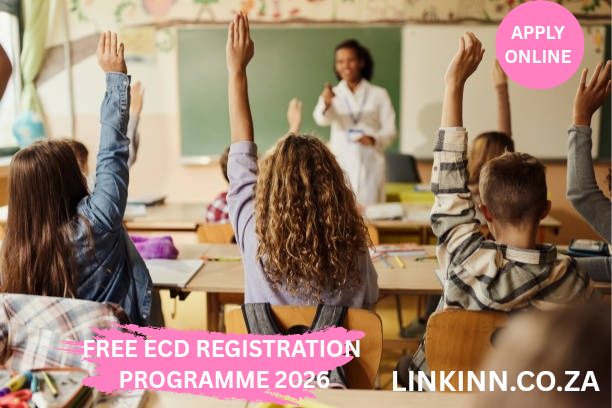
Early Childhood Development is globally recognised as one of the most powerful investments in a nation’s future. Research from UNESCO, the World Bank, and UNICEF consistently shows that quality early learning improves:
- School readiness
- Literacy and numeracy outcomes
- Long-term employment prospects
- Health and social well-being
The FREE ECD Registration Programme 2026 is South Africa’s response to these findings. By ensuring that every ECD programme meets minimum norms and standards, government is laying a foundation for equitable, high-quality early learning.
For international readers in the US, UK, and Canada, this initiative mirrors similar regulatory frameworks used to ensure quality and child safety in early learning centres.
3. Is ECD Registration Really Free?
Yes. ECD registration is completely free.
The Department of Basic Education has clearly stated:
“Please note that ECD registration is free. Do not pay anyone for registration support.”
No fees are charged for:
- Application submission
- Online registration
- Site assessments
- Certification (Bronze, Silver, or Gold)
If you become aware of a person or organisation charging ECD practitioners, report them to:
Email: banapele@dbe.gov.za
4. Who Must Register Under the Programme?
The FREE ECD Registration Programme 2026 applies to all ECD programmes, including:
- Community-based ECD centres
- Private crèches and preschools
- NGO-supported early learning programmes
- Faith-based ECD centres
- Home-based ECD programmes
Whether you operate in an urban suburb, rural village, informal settlement, or township, registration is encouraged and supported.
5. The Vision Behind Bana Pele
“Bana Pele” means “Children First”.
The vision of the Bana Pele ECD Registration Drive is to ensure that every young child in South Africa has access to:
- Quality learning and development opportunities
- A safe and nurturing environment
- Adequate nutrition
Registration is the first and most important step in achieving this vision.
6. The Three-Stage Registration Process Explained
The FREE ECD Registration Programme 2026 uses a three-stage approach designed to support, not punish, ECD programmes.
Every programme moves through:
- APPLY
- COMPLY
- COMPLETE
Each stage is explained in detail below.
7. Stage 1: APPLY – Bronze Certificate
At the APPLY stage:
- The ECD programme submits an application
- Applications can be completed online or via WhatsApp Bot
- Minimal information is required to get started
Once submitted, the programme receives a Bronze Certificate, confirming that it is officially in the registration system.
This approach ensures immediate inclusion, even before full compliance is achieved.
8. Stage 2: COMPLY – Site Visits and Documentation
During the COMPLY stage:
- The programme submits outstanding documents
- Site visits are conducted
- Compliance with ECD norms and standards is assessed
NGOs and provincial partners may assist during this phase, particularly for under-resourced centres.
9. Stage 3: COMPLETE – Silver and Gold Certification
At the COMPLETE stage:
- Fully compliant programmes receive:
- Silver Certificate or
- Gold Certificate
These certificates confirm that the programme meets national ECD standards and is eligible for further government support.
10. The eCares Online Registration System
The eCares system is the digital backbone of the FREE ECD Registration Programme 2026.
It is designed to be:
- Simple
- Mobile-friendly
- Accessible in low-bandwidth areas
Apply here:FREE EDC REGISTRATION PROGRAMME 2026
The system includes:
- Online application forms
- WhatsApp Bot support
- Step-by-step guidance
11. 7 Simple Application Steps
Although the system is digital, the process is straightforward:
- Access the eCares registration portal
- Create a profile
- Enter ECD programme details
- Upload basic documents
- Submit application
- Receive Bronze Certificate
- Proceed to compliance support
Registration is free at every step.
12. Required Registration Documents
Commonly requested documents include:
- Identity documents of practitioners
- Proof of address
- Health and safety information
- Programme details
Support is available for programmes that lack documentation.
13. Role of NGOs in the Registration Drive
NGOs play a critical role in the FREE ECD Registration Programme 2026.
They:
- Assist with applications
- Support compliance readiness
- Help programmes navigate documentation
A list of supporting NGOs in Gauteng is published on the DBE platform.
14. Provinces and Roll-Out Phases
The registration drive is being implemented in phases:
- Pilot sites launched in Gauteng
- Lessons from pilots guide national rollout
- Partnership with provinces ensures scalability
This phased approach ensures system stability and long-term success.
15. Benefits of Registering Your ECD Programme
Registered ECD programmes benefit from:
- Legal recognition
- Access to government support
- Improved trust from parents
- Better learning outcomes
- Long-term sustainability
Internationally, registered ECD centres are consistently associated with higher quality standards.
16. Common Mistakes and Scams to Avoid
Avoid:
- Paying anyone for registration
- Using unofficial websites
- Submitting false information
Always use official DBE channels and report fraud immediately.
17. FAQs: FREE ECD Registration Programme 2026
Is the FREE ECD Registration Programme 2026 compulsory?
Yes. Registration is required for all ECD programmes.
Can NGOs charge for assistance?
No. Registration support must remain free.
What if my centre is not fully compliant yet?
The system is designed to support gradual compliance.
Where can I get help?
Email: banapele@dbe.gov.za
18. Useful Links and Contacts
- Official Registration Portal: https://user-registration.dbecares.gov.za/
- Department of Basic Education: https://www.education.gov.za/
- ECD Resources and Opportunities: https://www.linkinn.co.za/
DBE Call Centre: 0800 202 933
19. Final Thoughts
The FREE ECD Registration Programme 2026 represents a bold, inclusive step toward quality early childhood education for every child.
By removing financial barriers, simplifying processes, and partnering with NGOs, the Bana Pele ECD Registration Drive places children first—where they belong.
If you operate an ECD programme, start your registration today. It is free, supported, and essential for the future of South Africa’s children.