
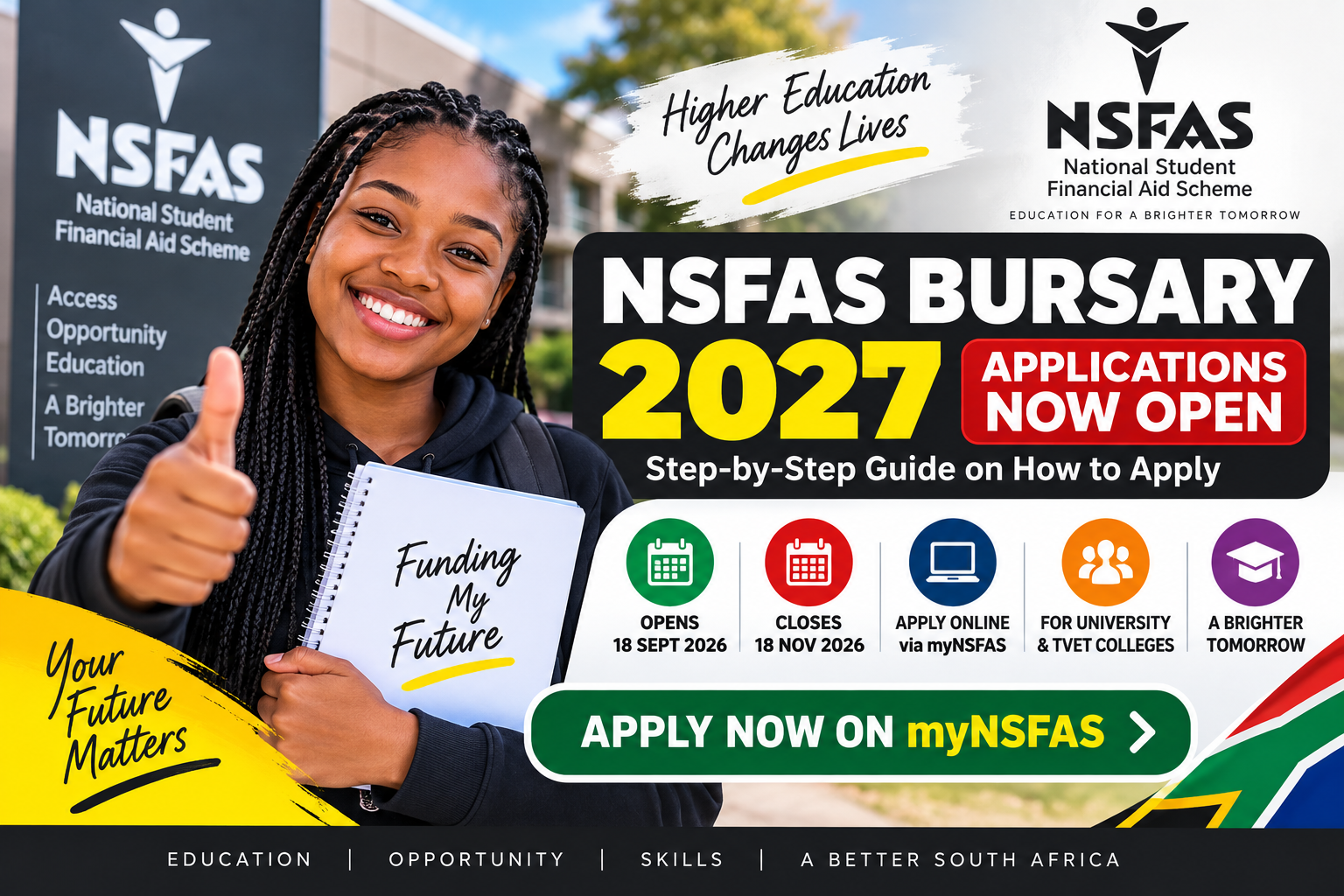
How to Apply for NSFAS Bursary 2027: Step-by-Step Guide
NSFAS 2027 Applications Are Now Open
Applications for the NSFAS 2027 academic year are officially open.
The 2027 application cycle opened on 18 September 2026 and will close on 18 November 2026. The Department of Higher Education and Training says successful funding outcomes are expected to start being communicated in December 2026. (Government of South Africa)
If you plan to study at a public university or TVET college in 2027 and need financial assistance, this guide explains how to apply.
NSFAS 2027 Application Overview
NSFAS 2027 Applications Are Now Open
| Details | Information |
|---|---|
| Funding | NSFAS Bursary 2027 |
| Applications Open | 18 September 2026 |
| Closing Date | 18 November 2026 |
| Study Year | 2027 |
| Institutions | Public universities and TVET colleges |
| Application Method | Online / NSFAS mobile app |
| Main Portal | myNSFAS |
| Application Cost | Free |
| Funding Outcomes | From December 2026 |
The opening and closing dates were announced when the 2027 NSFAS application cycle was officially launched on 18 September 2026. (Government of South Africa)
Who Can Apply for NSFAS in 2027?
NSFAS 2027 Applications Are Now Open
NSFAS states that South African citizens and permanent residents who plan to study, or are already studying, at an eligible public university or TVET college can apply for funding. (NSFAS)
For the bursary, the current income rules include:
- Non-SASSA applicants: combined household income of R350 000 or less per year
- Verified SASSA grant recipients: automatically meet the financial eligibility requirement
- Applicants living with disabilities: combined household income of R600 000 or less per year
Applicants must still meet the other NSFAS academic and funding requirements. (NSFAS)
Households earning between R350 001 and R600 000 may fall under the NSFAS student-loan category rather than the bursary, depending on the applicable requirements. (NSFAS)
How to Apply for NSFAS Bursary 2027
NSFAS 2027 Applications Are Now Open
Step 1: Visit the Official NSFAS Website
Start on the official NSFAS website.
Do not pay someone to apply for you. NSFAS applications can be completed directly online.
Step 2: Create a myNSFAS Profile
If you do not already have an account, create a myNSFAS profile.
You can access the official portal here:
Create or access your myNSFAS account
NSFAS says creating a myNSFAS profile is the first step in the application process. Make sure your personal information is correct. (NSFAS)
Use your own active cellphone number and email address so that you receive application updates.
Step 3: Log In and Select “Apply”
After creating your profile:
Log into myNSFAS and select Apply.
Complete all the information requested on the application form.
NSFAS advises applicants to provide accurate information because financial and personal details may be checked against third-party databases. (NSFAS)
Step 4: Complete Your Personal and Household Information
You may need to provide information about yourself and, depending on your circumstances, your:
- Parents
- Legal guardian
- Spouse
- Household income
Make sure names and ID numbers are entered correctly.
Incorrect details can delay your application.
Step 5: Upload the Required Documents
The documents needed are not exactly the same for every applicant.
NSFAS says its application system will determine which supporting documents you need based on your individual application. (NSFAS)
One important document is the NSFAS Consent Form. NSFAS uses this form to obtain permission to verify financial information through third-party sources. An incomplete or unsigned consent form can prevent the application from being assessed. (NSFAS)
Other forms may be requested depending on your circumstances, including a:
Declaration Form – where NSFAS cannot verify normal parent or guardian details.
Disability Assessment/Annexure Form – for applicants living with disabilities where applicable.
Orphan or Vulnerable Child Form – for qualifying applicants under 18 who cannot provide normal parental information. (NSFAS)
Have your ID details and household-income information ready before starting the application. NSFAS may request additional supporting documents depending on your situation. (NSFAS)
Step 6: Check Everything Before Submitting
Before selecting Submit, carefully check:
Your ID number, name, cellphone number, email address, household details and uploaded documents.
Make sure all documents requested by the system have been uploaded.
NSFAS specifically advises applicants to confirm that their information and required documents are correct before submitting. (NSFAS)
Step 7: Submit Your NSFAS Application
Once everything is correct, submit your application.
Do not stop after filling in the form. Make sure the application has actually been submitted.
NSFAS’s application guidance says applicants receive confirmation/reference information after successfully completing the process. (NSFAS)
Step 8: Track Your Application
After applying, regularly log into your myNSFAS account.
Track your NSFAS application through myNSFAS
Check for requests for additional documents or changes to your application status.
NSFAS recommends keeping your contact details updated so that you receive important application information. (NSFAS)
What Does the NSFAS Bursary Cover?
For eligible students, the NSFAS bursary can cover approved education-related expenses including:
Registration and tuition fees
Learning materials
Living allowance
Personal-care allowance
Transport or accommodation, where applicable. (NSFAS)
The exact allowances depend on the applicable NSFAS rules, institution and individual circumstances.
Can Matric Learners Apply for NSFAS 2027?
Yes.
Grade 12 learners who plan to enter an eligible public university or TVET college in 2027 can apply during the application period.
You do not have to wait until the beginning of 2027 to start your NSFAS application. The official 2027 application cycle is already open. (Government of South Africa)
Do You Need University Acceptance Before Applying?
NSFAS says people who plan to study at a public university or TVET college can apply for funding. Final funding is subject to meeting the applicable conditions and registration for an approved programme. (NSFAS)
You should therefore also apply separately for admission to the university or TVET college where you want to study.
A NSFAS application is not the same as an application for university or college admission.
The Higher Education Minister specifically reminded prospective students that admission and NSFAS funding are two separate steps. (Government of South Africa)
Which Institutions Does NSFAS Fund?
NSFAS funding applies to eligible programmes at:
Public universities
and
Public TVET colleges.
NSFAS does not fund students studying at private institutions under its standard bursary scheme. (NSFAS)
Can SASSA Beneficiaries Apply?
Yes.
NSFAS says verified SASSA grant recipients automatically meet the bursary’s financial eligibility requirement, although the other applicable funding conditions still need to be met. (NSFAS)
Can Students With Disabilities Apply?
Yes.
Applicants living with disabilities may qualify for the bursary where combined household income is R600 000 or less per year, subject to the other eligibility requirements. (NSFAS)
Eligible students with disabilities may also qualify for certain additional approved support, such as assistive devices and other disability-related assistance. (NSFAS)
NSFAS 2027 Closing Date
The official closing date is:
18 November 2026
The 2027 cycle opened on 18 September 2026. (Government of South Africa)
Applicants are encouraged to apply early rather than waiting until the closing date.
Applying early gives you more time to correct information or provide documents if NSFAS requests them.
Important Mistakes to Avoid
Do not wait until 18 November to start your application.
Do not enter a cellphone number or email address you cannot access.
Do not leave requested documents missing.
Do not submit incorrect household-income information.
Do not share your myNSFAS password or login details with strangers. NSFAS warns applicants that its officials will not ask for their password. (NSFAS)
And do not pay someone who promises to guarantee NSFAS funding.
Official NSFAS Application Links
Use only official NSFAS channels:
The South African Government also confirms that NSFAS applications are made online and provides NSFAS funding information through its official services portal. (Government of South Africa)
Frequently Asked Questions
Are NSFAS applications for 2027 open?
Yes. Applications officially opened on 18 September 2026. (Government of South Africa)
When do NSFAS 2027 applications close?
18 November 2026. (Government of South Africa)
How do I apply?
Create or log into your myNSFAS account, select Apply, complete the application, upload the documents requested by the system and submit it. (NSFAS)
How much must my family earn to qualify for the bursary?
For most non-SASSA applicants, combined household income must be R350 000 or less per year. For applicants living with disabilities, the threshold is R600 000 or less. (NSFAS)
Does NSFAS fund private colleges?
The standard NSFAS bursary does not fund private institutions. Funding is for eligible programmes at public universities and TVET colleges. (NSFAS)
Is NSFAS application free?
You should apply directly through NSFAS. Do not pay anyone to submit the online application for you.
When will applicants know the outcome?
At the 2027 application-cycle launch, the Department said funding outcomes would begin being communicated to successful applicants in December 2026. (Government of South Africa)
Final Reminder
The NSFAS 2027 application cycle is now open.
Remember these important dates:
Opening date: 18 September 2026
Closing date: 18 November 2026
Funding outcomes: From December 2026. (Government of South Africa)
Apply through the official myNSFAS portal, complete all required information, upload the documents requested for your application and submit before the deadline.
Apply for NSFAS 2027 through myNSFAS
About the Author
Mr Josh writes simple bursary, learnership, internship, job and career guides for Linkinn.co.za. His content focuses on helping South African students and job seekers understand application requirements and find legitimate official application channels.
Editorial and Verification Note
This guide was updated on 18 September 2026, the day the 2027 NSFAS application cycle officially opened. Application dates, eligibility information and application steps were checked against NSFAS and South African Government sources. (Government of South Africa)
Disclaimer
Linkinn.co.za is an independent education and opportunity information website.
Linkinn.co.za is not NSFAS, the Department of Higher Education and Training, a university or a TVET college. It does not approve funding or accept NSFAS applications.
Applicants must submit their applications through the official NSFAS channels.