
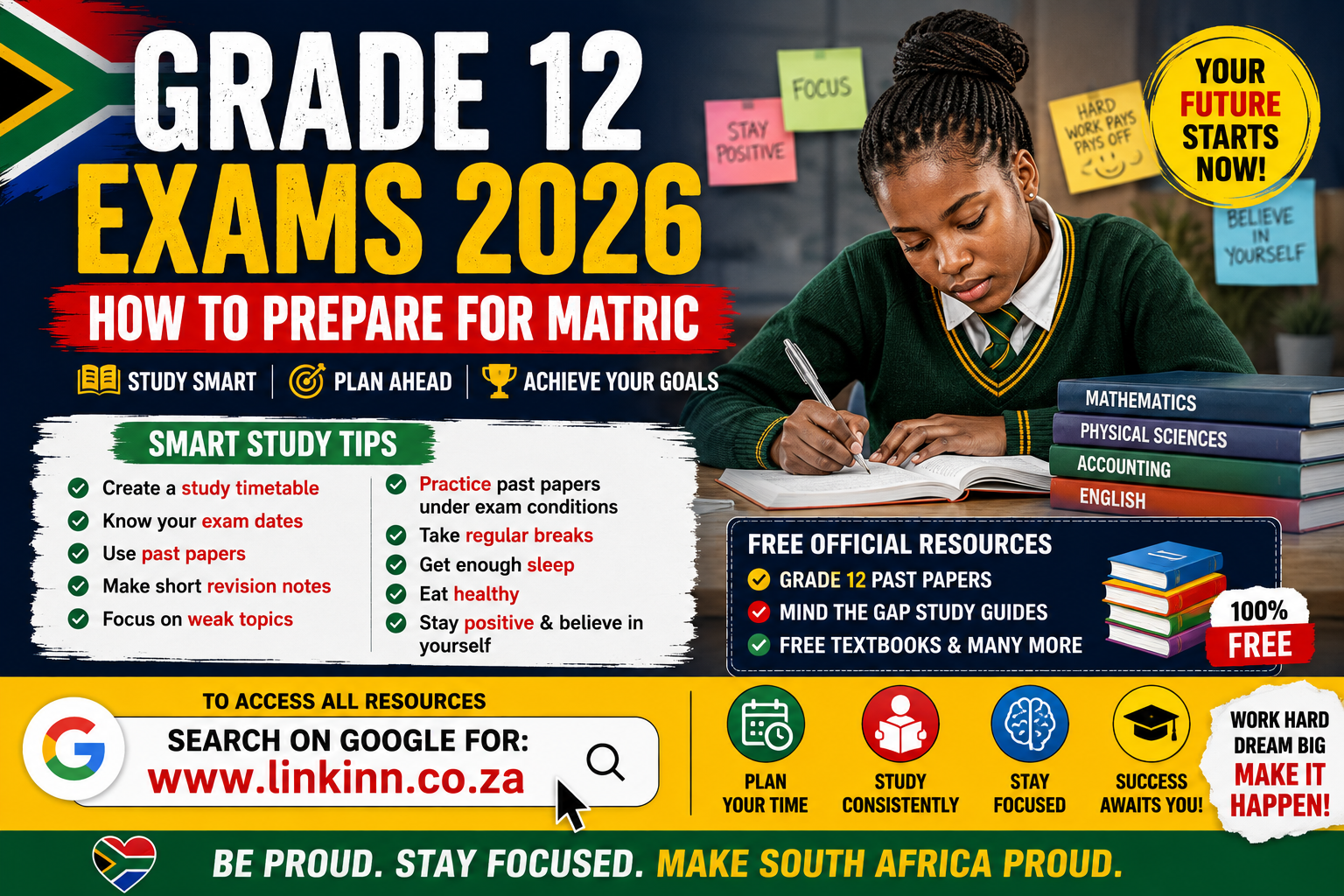
How to Prepare for Grade 12 Exams in 2026: Matric Study Guide for South African Learners
How to Prepare for Grade 12 Exams in 2026
The final Grade 12 examinations are one of the biggest academic milestones for South African learners.
If you are writing the 2026 National Senior Certificate (NSC) examinations, now is a good time to move from ordinary studying to focused exam preparation.
The Department of Basic Education has published the October/November 2026 NSC examination timetable. The timetable begins with certain practical and language examinations in October, with major subjects continuing through October and November. (Department of Basic Education)
Good preparation doesn’t mean studying every hour of the day. A better approach is to identify what you don’t understand, create a realistic timetable, practise regularly and use previous examination papers to test yourself.
Here is a practical guide.
1. Download the Official 2026 Matric Exam Timetable
Start with the examination timetable.
Knowing your exam dates helps you determine which subjects need attention first and how much preparation time you have.
For example, according to the official 2026 timetable:
- Mathematics/Mathematical Literacy Paper 1 – 23 October
- Mathematics/Mathematical Literacy Paper 2 – 26 October
- English HL/FAL/SAL Paper 1 – 28 October
- Physical Sciences Paper 1 – 30 October
- Physical Sciences Paper 2 – 2 November
These are only examples; learners should check the complete timetable for their own subjects. (Department of Basic Education)
Official DBE 2026 NSC Examination Timetable
Print it if possible or keep an accessible copy on your phone.
2. Create a Realistic Study Timetable
Don’t simply write “study Maths” on your timetable.
Break each subject into smaller topics.
Instead of:
Monday: Mathematics
Try:
Monday: Mathematics – Algebra and Functions
Then Tuesday could focus on another topic.
Your timetable should give extra attention to subjects and topics you find difficult without completely ignoring your stronger subjects.
Try using manageable study sessions with regular breaks. What matters most is whether you are concentrating and understanding the work—not simply how many hours you can claim to have studied.
3. Identify Your Weakest Topics
Take a notebook and divide a page into three categories:
Strong: Topics you understand confidently.
Needs revision: Topics you understand but still make mistakes on.
Difficult: Topics you regularly struggle to answer.
Spend more revision time on the second and third categories.
This prevents you from repeatedly studying topics you already know simply because they feel easier.
4. Use Grade 12 Past Exam Papers
Past examination papers should become an important part of your Matric preparation.
The Department of Basic Education specifically recommends previous examination papers for revision because they help learners identify what they already know and what they still need to work on. (Department of Basic Education)
Download Official Grade 12 Past Exam Papers
Don’t immediately look at the memorandum.
Attempt the questions yourself first.
Afterwards, mark your answers and identify where you lost marks.
Keep a list of those mistakes and revise the relevant topics.
5. Practise Under Exam Conditions
Once you understand most of the content, start doing complete papers.
Set aside the amount of time allocated for the real paper, put away unnecessary distractions and attempt the examination without checking answers.
When the time ends, stop.
Then mark your work using the memorandum.
This helps you practise answering questions while managing the limited time available during an examination.
6. Don’t Just Memorise — Understand
Memorising can help with certain facts and definitions, but many Grade 12 questions require you to apply what you know.
Ask yourself:
Can I explain this topic without looking at my textbook?
If the answer is no, you probably need more revision.
One useful technique is to explain the concept in your own words as though you were teaching another learner.
If you cannot explain it simply, return to your notes and work through it again.
7. Use the Free Mind the Gap Study Guides
You don’t necessarily need expensive study materials.
The Department of Basic Education provides Mind the Gap Grade 12 study guides aligned with CAPS. (Department of Basic Education)
Free Grade 12 Mind the Gap Study Guides
Use these alongside your school notes, textbooks and past papers rather than constantly switching between many different resources.
8. Make Short Revision Notes
Turning an entire textbook into another enormous notebook is rarely the most efficient way to revise.
Instead, create shorter summaries containing important information such as:
- Formulas
- Definitions
- Key concepts
- Diagrams
- Important dates
- Processes
- Common mistakes
- Difficult terminology
Your revision notes should help you quickly remember what you have already learned.
9. Practise Mathematics Regularly
Mathematics is difficult to improve by reading solutions without actually attempting questions.
Practise calculations and problems regularly.
If you get something wrong, determine why.
Was it because you didn’t understand the formula?
Did you make a calculation error?
Did you misunderstand the question?
Did you run out of time?
Understanding why you lost marks makes your revision more useful.
10. Prepare for Physical Sciences With Problems and Concepts
Physical Sciences requires both conceptual understanding and problem-solving.
Know your important concepts and formulas, but also practise applying them to examination questions.
The official 2026 timetable currently schedules Physical Sciences Paper 1 for 30 October and Paper 2 for 2 November. (Department of Basic Education)
Use past papers to become familiar with the way questions are structured.
11. Take Languages Seriously
Languages can contribute significantly to your final results.
Don’t focus only on Maths and Science while neglecting English, Afrikaans or another language.
Prepare for comprehension, writing, literature, grammar and other components required by your subject.
Practise writing answers clearly and within the allocated time.
12. Use Active Recall
Instead of repeatedly reading the same page, close the book and try to remember the information.
For example, read a section about a topic.
Close your notes.
Write down everything you remember.
Open the notes again and compare.
Anything you missed becomes part of your next revision session.
This turns studying into an active exercise rather than passive reading.
13. Reduce Phone Distractions
Your phone can be useful for study materials, calculators where appropriate, videos and communication.
It can also easily consume an entire study session.
When studying, silence unnecessary notifications and move distracting apps out of reach.
You don’t have to avoid your phone completely. Create boundaries so that a five-minute check doesn’t become an hour of scrolling.
14. Ask for Help Early
Don’t spend weeks pretending to understand something you don’t.
Ask your teacher to explain the topic again.
You can also work with classmates who understand the subject, attend revision sessions offered by your school or use reputable educational resources.
Write down specific questions before asking for help.
Instead of saying:
“I don’t understand Maths.”
Identify the problem:
“I don’t understand how to answer this type of functions question.”
That makes it easier for someone to help you.
Free Grade 12 Study Resources
How to Prepare for Grade 12 Exams in 2026
The Department of Basic Education provides several useful resources for Matric learners.
Its Second Chance Programme resource page brings together past examination papers, study guides, revision materials and other learning resources. (Department of Basic Education)
DBE Second Chance Matric Study Resources
The DBE also provides digital state-owned textbooks that can be downloaded free of charge. (Department of Basic Education)
These official resources are worth checking before paying for additional revision material.
What to Do One Month Before Exams
How to Prepare for Grade 12 Exams in 2026
By this stage, your revision should become increasingly exam-focused.
Spend more time answering questions and less time simply rereading textbooks.
Work through previous papers, mark your answers and return to topics where you continue losing marks.
Keep your study timetable realistic.
You still need time to sleep, eat properly, attend school and complete other responsibilities.
What to Do One Week Before an Exam
How to Prepare for Grade 12 Exams in 2026
Avoid trying to learn an entire subject from the beginning.
Concentrate on:
- Important concepts
- Formulas
- Definitions
- Previous mistakes
- Frequently tested skills
- Past-paper questions
Check the official timetable again so that you know the correct date and starting time for your paper.
Prepare what you need for the examination according to your school’s instructions.
The Night Before an Exam
Use the evening for focused revision rather than trying to study everything.
Review your summaries and areas that need a final check.
Then give yourself enough time to sleep.
Arriving at an examination exhausted after studying all night can make concentration harder.
On the Day of the Exam
Arrive according to the instructions provided by your school or examination centre.
Once you receive the paper, read the instructions carefully.
Pay attention to:
- Number of questions
- Required sections
- Mark allocation
- Time available
Don’t spend so much time on one difficult question that you cannot attempt easier questions later.
If you become stuck, move on where the paper allows and return to the question later.
What Marks Do You Need to Pass Matric?
Learners should understand that obtaining the NSC and qualifying for admission to a particular university programme are different things.
According to the Department of Basic Education’s NSC examination information, the minimum certificate requirements include achieving 40% in three subjects, including an official language at Home Language level, and 30% in three other subjects, subject to the complete policy requirements. (Department of Basic Education)
But don’t build your study plan around achieving only the minimum.
Universities, colleges, bursaries and individual programmes can have considerably higher subject and admission requirements.
Aim for the strongest results you can realistically achieve.
A Simple Weekly Matric Study Plan
You could structure a week something like this:
| Day | Main Focus |
|---|---|
| Monday | Difficult Subject 1 + Language |
| Tuesday | Difficult Subject 2 + Past-paper questions |
| Wednesday | Subject 3 + Difficult Subject 1 |
| Thursday | Subject 4 + Language |
| Friday | Weak topics and corrections |
| Saturday | Timed past paper + marking |
| Sunday | Light revision + plan the next week |
This is only an example. Your timetable should reflect your subjects, school commitments and areas requiring improvement.
Frequently Asked Questions
When are the 2026 Matric final exams?
The official October/November 2026 NSC timetable begins with certain practical and language examinations in October, followed by the wider examination programme. Check your individual subjects on the official timetable. (Department of Basic Education)
Where can I download Grade 12 past papers?
The Department of Basic Education provides previous Grade 12 examination papers online. (Department of Basic Education)
Are there free Grade 12 study guides?
Yes. The DBE’s Mind the Gap study guides are available for Grade 12 revision and are CAPS-aligned. (Department of Basic Education)
How many hours should a Matric learner study?
There isn’t one perfect number for every learner. Focus on consistent, concentrated sessions and measurable progress rather than competing over study hours.
Is doing past papers enough?
Past papers are extremely useful, but combine them with understanding the curriculum, correcting mistakes, revising weak topics and getting help when necessary.
Final Grade 12 Exam Checklist
Before your 2026 exams, make sure you have your official examination timetable, a realistic revision plan, past papers and memoranda, subject notes and appropriate study guides.
Most importantly, practise answering questions.
Reading notes can make material feel familiar, but attempting exam questions shows whether you can actually use what you have learned.
Final Word
Knowing how to prepare for Grade 12 exams in 2026 comes down to starting early enough, working consistently and using your remaining time wisely.
Download the official timetable. Identify your weak areas. Use the Department of Basic Education’s free past papers and Mind the Gap study guides, and practise answering questions under realistic conditions. (Department of Basic Education)
Your goal doesn’t need to be a perfect study routine. Build a routine you can actually follow and improve it as the exams get closer.
Useful Official Resources
Grade 12 Past Examination Papers
Mind the Gap Grade 12 Study Guides
Second Chance Matric Resources
About Linkinn
Linkinn.co.za provides South African education, career, bursary, learnership and employment information. Learners should verify examination dates and official education information with the Department of Basic Education and their school.